

Nov 11 – St Martin of Tours (1) 316-397: patron of France
Summary : St Martin of Tours, bishop. Born in Pannonia (Hungary) about 316; he died in 397 and was buried on this day in Tours (France). A catechumen who was in conscience unable to continue with military service, was baptised at the age of eighteen, for a time became a hermit, worked to establish monasticism in the West and was Bishop of Tours for twenty-five years. Widely remembered for his legendary generosity to the poor, for arguing against the persecution of heretics, and especially for his active evangelisation and pastoral care of rural areas.
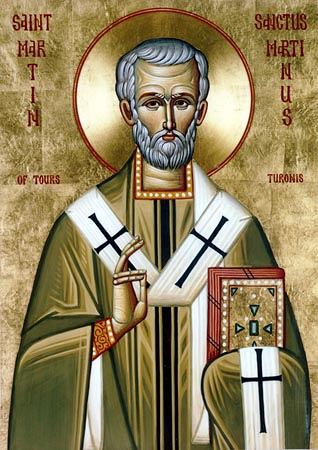
Patrick Duffy tells his story.
Introduction
Martin was born about 316 at Sabaria, Pannonia (modern Szombathely, Hungary), where his father was an officer in the Roman army. He was named after Mars, the god of war, which his biographer St Sulpicius Severus (360-425) interprets as meaning “the brave, the courageous”. His father was transferred back to Ticinum (modern Pavia, near the Po river in Italy). At that time due to the conversion of Constantine, Christianity had come into favour in the military camps. However, it was against the wishes of his parents that Martin became a catechumen or candidate for baptism at the age of ten.
Sharing his Cloak
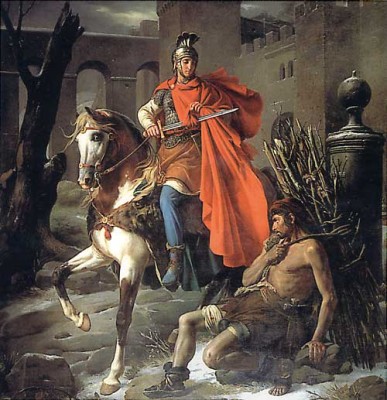
Baptism
Soon after this Martin had himself freed from military service, which was then considered incompatible with being a Christian. He was baptised and almost immediately went to Poitiers to become a disciple of St. Hilary (300-367), a wise and pious bishop.
Against the Arians
At that time Arianism, which held that Jesus (the Word) was created and therefore a lesser being than God the Father, was being promoted by the local Visigothic nobility and threatened the true Trinitarian doctrine. Hilary of Poitiers, because he opposed this doctrine, got the nickname “the hammer against Arianism” (malleus Arianorum). Later some Arians got into power and Hilary was forced to go into exile to Phrygia in Asia Minor, where he allied himself with St Athanasius and other supporters of the true doctrine.
Martin meanwhile went to Italy, where the Arians put pressure on him too. Auxentius, the Arian archbishop of Milan, expelled him from the city. He went to the island of Gallinara in the Mediterranean Sea (modern Isola d’Albenga, between San Remo and Genoa) where he lived the life of a hermit.
When Hilary returned briefly to Poitiers 361, Martin joined him there and established a monastery nearby which later developed into the Benedictine Ligugé Abbey. From there he travelled through Western Gaul evangelising and many legends of his travels remain
Bishop of Tours
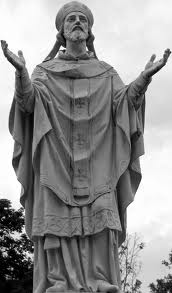
Interceding for Priscillian
Priscillian was a Christian ascetic and mystic from Spain who held that for a Christian to be in continuous communication with God he had to renounce marriage. He was condemned as a heretic by the Council of Saragossa, he fled. But a Spanish bishop named Ithacius rushed to denounce him to the Emperor Maximus at Trier. Martin also hastened to Trier to ask for mercy and have the case removed from secular jurisdiction. The Emperor at first agreed, but, when Martin had gone away, he gave in to the Spanish bishops and ordered Priscillian and his followers to be beheaded (385), the first Christians executed for heresy. Martin was deeply grieved by this and refused to communicate with Ithacius, until pressured by the Emperor.
Death and Influence
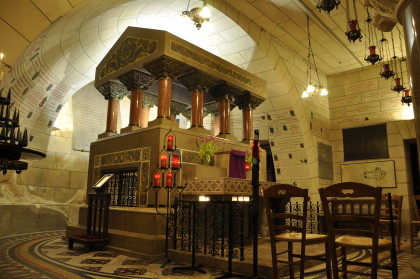
Patron Saint of France
Martin was different from most of his colleague bishops in Gaul at the time. They had moved to the episcopacy from being upper-class leaders in the civil sphere whereas Martin, who resigned from military service to become baptised, was a Christian by conviction. He also had an affinity with the poor and the country people, the pagani, whom he moved out to evangelise. He is a patron saint of France. Because of Martin’s influence in establishing Christianity there (along with King Clovis a little later), France is often referred to as ‘the eldest daughter of the Church’.
Customs
A number of customs take place in rural communities around the season called Martinmas that are associated with generosity to beggars, cooperation and neighbourliness. For example, a pig or a cow is killed and cooked at this time and shared in honour of Martin. It is also a time for making black puddings and haggis. Martin has also a place of honour in Ireland, especially in the dedications of holy wells and place names, such as Desertmartin in county Derry. A season of mild weather in the middle of November is called St Martin’s summer.
________________________
******************************
Memorable Sayings for Today
“We can only be truly generous
when we expect nothing in return.” ~ Muhammad Ali ~
“Rings and jewels are not gifts, but apologies for gifts.
The only gift is a portion of thyself.”
~ Ralph Waldo Emerson ~
“The more one forgets himself
-by giving himself to a cause to serve or another person to love
– the more human he is.”
– Viktor E. Frankl
******************************
Summary: Martin of Tours Like St Ambrose of Milan, Martin was an army man who picked up the Christian ethos that had crept into the army through Constantine. Clovis, a century later, became a Christian through his wife Clothilde. Through them the story of France and the Franks is intertwined with that of the Church.
On one of his trips to France, John Paul II asked if it had been true to its baptismal vocation. Saint Martin of Tours and King Clovis had much to do with that baptism which has made many refer to France as ‘the eldest daughter of the Church’.
Desmond O’Grady tells that story here.
Roman Soldier

Most bishops of Gaul had been drawn from those who were Roman Senators. They moved from being leaders in the civil sphere in the Church whereas Martin had a more profoundly religious background. He was tireless in his efforts to evangelise peasants who were still pagan and he established a rudimentary parochial system in his diocese. After his death in AD 397 his tomb became the focus of pilgrimages because of his reputation for sanctity. He is a patron saint of France.

Julius Caesar had written that Gaul was divided into three parts but shortly after the fall of the empire it was divided into seven parts because of tribal, dynastic and religious conflicts.
Most of the Germanic tribes which overran the territories inhabited by Gauls were Christian but heretical. They had been evangelised by Arians, who believed that as Christ suffered and died on the Cross he could not be the equal of God the Father. In Arian societies, the king exercised authority even in Church matters.

Clovis was a pagan Germanic chieftain with one sister who was likewise a pagan and another who was an Arian. His kingdom (of Franks), situated largely in what is now north-central France and Belgium, was smaller than the Arian kingdoms of the Visigoths in Burgundy and the Vandals of Provence and Spain who had the backing of the Ostrogothic kingdom of Italy and the Vandals of north Africa.
He could have become an Arian himself because, for a time, one of his sisters was married to Theodoric, the Ostrogothic king of Italy. However, his wife, Clothilde, a Burgundian princess, was a Catholic and she tried to convince him of the truth of the faith.
In AD 496 another German tribe attacked the Franks along the Rhine. They appealed to Clovis for help but he arrived late with his troops. They were on the verge of defeat when Clovis invoked the help of Clothilde’s God, vowing that if he were victorious he would be baptised. He was victorious.
Fear of Rebellion
Historians used to claim that he accepted Catholicism immediately but, in fact, he did not fulfil his promise just then. Clothilde convinced him to take instruction from Bishop Remy of Rheims. Clovis did so in secret to avoid rebellion by his troops, who believed in the powerful God of war, Wotan, who was a winner rather than an apparent loser like Christ, who had died an ignominious death on a cross.
Still not persuaded to accept baptism, Clovis consulted with a former soldier, Vaast, who had become a hermit and mystic. The king was impressed by Vaast and made him his travelling companion for some time.
After being defeated twice by Visigoth forces near Bordeaux in A.D. 498, Clovis arrived at Tours on St. Martin’s feast day. There he was influenced by the many pilgrims, the cures which took place and the discussions he had with the priests of the sanctuary. After seven years examining the faith, he finally decided to be baptised.
Christmas Baptism
He wrote to all the bishops of Gaul informing them that he was entering the second phase of the catechumenate. (the first phase was that in which the catechumen listened to explanations; the second insisted on a written request for baptism).
Usually baptisms took place at Easter but his was arranged for Christmas Day to signify the birth of a Christian king. It used to be considered that the year was AD 496 but now it is thought it was either AD 498 or AD 499.
One bishop who could not attend (because he lived under Arian-Gothic domination) wrote to Clovis saying, ‘your faith is our victory’. Some claim it must have required conviction and courage for Clovis to choose Catholicism when the adjoining kingdoms were Arian; others say it was a shrewd calculation for his own advantage. In any case, he was the first barbarian king to make the choice.
As a military chieftain he had been faithful to imperial Rome and now he was declaring his allegiance to Peter and Paul as representatives of Christ. The barbarians had already invaded Rome several times and the capital of the Roman empire had shifted to Constantinople but that was a long way away. To a large extent, Clovis was isolated.
Before his death in AD 511 he had resounding victories over the Arian kings but it was not until AD 536 that his sons conquered Provence, extending the Franks’ control to the Mediterranean. Clovis established his capital in Paris and built there a church dedicated to Saints Peter and Paul, which was evidence of his fidelity to Rome.

Concubinage was practised by Germanic kings. They could have two free-women wives (the first was the official one with inheritance rights) and a third from among the slaves, but Clovis accepted Clothilde’s requirement of a monogamous marriage. (After Clovis’ death, Clothilde withdrew to St Martin’s sanctuary until her death in AD 548. She is now a canonised saint).
One of Clovis’ sisters who was pagan was baptised with him after publicly renouncing her former beliefs; the other also became a Catholic. Her baptism as an Arian was valid but she was confirmed when Clovis became a Catholic. To ensure Clovis’ safety, his personal guard of 3,000 men were baptised with him but the bulk of his troops maintained their pagan beliefs.
The Franks as a people did not automatically follow Clovis’ choice as did the people of the Kiev kingdom when Prince Vladimir was baptised there some 500 years later. In fact, when Clovis nominated Vaast as bishop in A.D. 500 he had a specific mandate to end the paganism which was still responsible for human sacrifice. It was not until much later that the French language fully replaced German and it was only in the 13th century that the kingdom of France was established.
Intertwined
So Clovis’ conversion did not mean that what is now France became Catholic. It was not a decision taken swiftly under the impulse of a military victory and involving a whole people. But it strengthened a Church which existed before the French nation and ensured that the story of France and the Franks would be intertwined with that of the Church.
This article first appeared in The Messenger (December 1998), a publication of the Irish Jesuits.
___________________________
******************************
Memorable Saying for Today
Giving, with strings attached is not generosity:
it is just another deal.
~ Marya Mannes ~
******************************